
Roofing Materials: Tile, Metal and Bitumen Shingles
Clay and concrete tiles, metal roofing and bitumen shingles compared: weight, roof pitch, noise, maintenance, climate and fit with architectural style.
The covering of a pitched roof is one of the largest surfaces shaping a house's appearance, but the choice is not just about colour and shape. The weight of the covering affects the roof structure, its form dictates the pitch required, and the material affects noise, maintenance and service life. To decide well, materials need to be compared against the same criteria.
Clay and concrete tiles
Natural clay tiles are fired from clay and are among the most traditional roof coverings. They hold their colour for a long time, do not burn and absorb rain noise well. Concrete tiles have a similar appearance and properties and come in a wide range of profiles.
The main characteristic of both is weight. A tiled roof is considerably heavier than other coverings, so the roof structure — rafters, their spacing and cross-section — must be designed for that load. If a light covering on an older house is to be replaced with tiles, whether the structure can take it must be checked.
Other points:
- each tile type needs its own minimum pitch and is not suitable for very low-pitched roofs;
- since tiles are individual units, the fixing specification needs attention in high-wind areas;
- a broken tile is easy to replace, which simplifies maintenance;
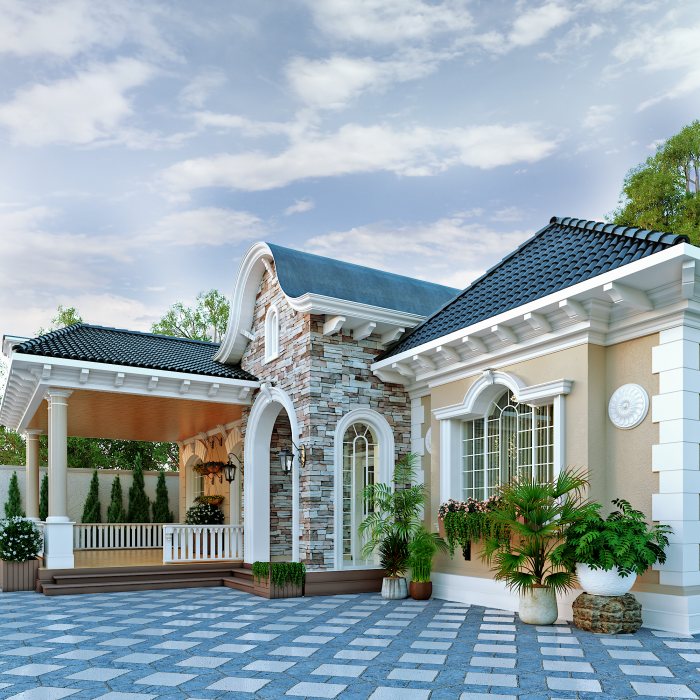
- tiles sit naturally on classic, Mediterranean and rustic-style villas.
Metal roofing
Metal roofing is a broad group: profiled sheets, tile-effect metal sheets and standing seam systems. Coated steel, aluminium, zinc and copper are used.
Metal's main advantage is its low weight: the load on the structure is small, and it can be used on relatively low pitches (the exact limit depends on the system type). Standing seam systems are popular in contemporary architecture: clean, long lines, a minimalist look, and the option to use the same system on both roof and facade.
Points to consider:
- rain noise is louder; a sound-absorbing insulation layer under the roof reduces it considerably;
- metal expands with temperature, and the fixing system must allow for that movement;
- on coated steel, cut edges and scratches can become corrosion points, and material choice is especially important near the sea;
- there is a risk of condensation beneath metal, so roof ventilation and a breathable membrane must be installed correctly;
- contact between different metals (for example copper and galvanised steel) can accelerate corrosion.
Bitumen shingles
Bitumen shingles are flexible sheets with a glass-fibre base, impregnated with bitumen and surfaced with mineral granules. They are bonded and nailed onto a continuous timber deck of plywood or OSB.
Their strength is complex roof shapes: domes, turrets and roofs with many valleys and hips. Their flexibility lets them follow almost any form with little waste. They absorb rain noise well and are light.
They have limitations too:
- they need a continuous deck, which is an extra layer in the roof build-up;
- depending on the product there is a minimum pitch requirement, and they are not used on very shallow roofs;
- how fast they age under direct sun in a hot climate depends on quality;
- on a poorly ventilated roof the deck can be damaged by moisture.
Selection criteria
When comparing materials, it helps to ask these questions in the same order:
- What weight can the roof structure carry, or is it being designed from scratch?
- Which materials do the roof pitch and shape allow?
- What are the local wind, snow load and proximity to the sea?
- How much does rain noise matter for the way the house is used?
- Which covering makes the house's architectural style look coherent?
- How will maintenance and repairs be carried out in future?
The covering does not work alone
Whatever material is chosen, the roof works as a system: under the covering there should be a breathable membrane, a ventilation gap, thermal insulation and a vapour barrier. Ridges, valleys, the areas around chimneys and roof windows, edge trims and gutters matter as much as the covering. Even the best tile can let water through a poorly formed valley.
When re-covering an old roof, it makes sense to use the opportunity to inspect the layers beneath. Once the covering is stripped, the condition of the rafters, signs of damp and rot in the timber, the quality of the old insulation and whether a ventilation gap exists are all clearly visible. Laying a new covering over an old, damaged base means returning to the same problems before long. This is also the easiest time to move or remove penetrations such as chimneys, roof windows and antennas.
Installing roof coverings is part of Zaferoğlu İnşaat's construction service, and material choice can be discussed together with the house's architectural design and structure.
News