
Facade Decor: Materials for Cornices, Columns and Surrounds
Comparing polystyrene, polyurethane, glass-fibre concrete and stone for cornices, columns and window surrounds, with rules for fixing and shedding water.
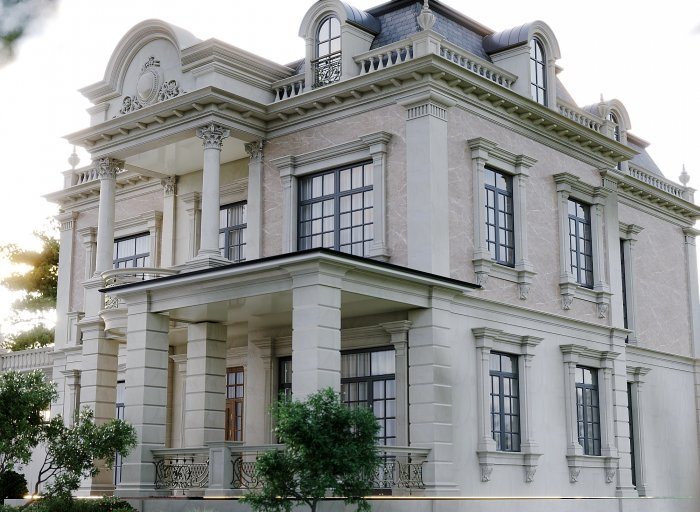
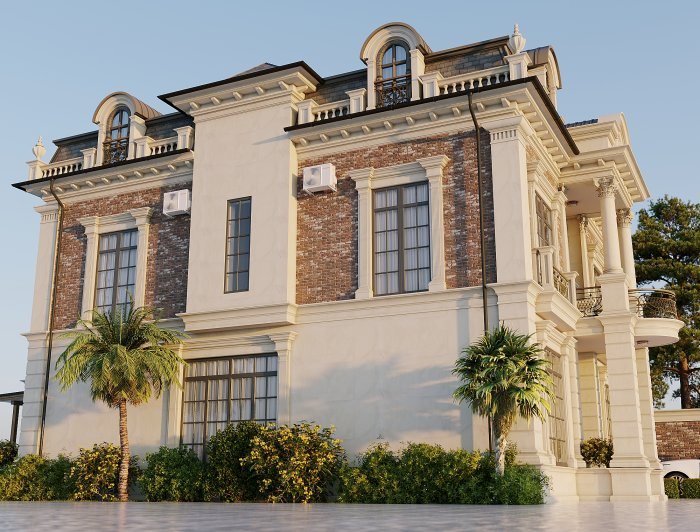
The character of a classic or neoclassical facade often comes not from the wall itself but from the details applied to it: cornices, window surrounds, columns, string courses, keystones. Elements that look identical in a sketch can be made from very different materials. The material decides the element’s weight, how it is fixed, how many years it will stay neat and how difficult repairs will be.
Three questions before choosing
The first question is location. Columns within reach and details near the plinth take knocks, while a second-floor cornice bears more sun and rain. The second is size: a deeply projecting cornice puts a serious load on the wall through its own weight and the water that collects on it. The third is the main facade system: will the decor be fixed to render, external insulation, stone cladding or a ventilated facade? Without these answers, choosing a material purely on looks can lead to cracks and detachment later.
Coated polystyrene elements
These consist of a cut expanded polystyrene core covered with a reinforced mineral coating. Being very light, they are easily bonded to walls, especially insulated facades. Almost any profile can be cut to order, and installation is fast.
Their weakness is sensitivity to impact: if the coating is thin, a ball or a ladder can leave a dent. It therefore makes sense to use them out of reach and to specify coating thickness when ordering. If the coating cracks, water can get into the foam and separate the layers as it freezes, so cracks need prompt repair.
When ordering, it is also important to check elements against the dimensions on the facade drawings. A cornice profile should be proportioned to the wall height and a window surround to the size of the opening; an off-the-shelf catalogue profile often looks either too small or too heavy. Corners and arched openings need specially cut pieces, and their number is worked out in advance.
Polyurethane mouldings
Polyurethane elements are dense, smooth and finely detailed. They reproduce complex ornament, small corbels and decorative surrounds accurately, are light and do not absorb moisture. For exterior use, choose ranges the manufacturer confirms as suitable for outdoors, and always paint them with facade paint, because unpainted surfaces degrade in sunlight.
The material changes length with temperature. If joints between long cornice runs are not made with a flexible adhesive sealant, they open up in summer and winter.
Glass-fibre and cast concrete
Fibre-reinforced concrete — thin-walled concrete strengthened with fibres — strikes a good balance between strength and detail. Its surface looks close to stone, it resists impact and it does not burn. It is often chosen for large column shafts, balusters, window surrounds and cornices.
Because it weighs far more than foam or polyurethane, fibre-reinforced concrete is usually fixed not just with adhesive but with stainless anchors or metal brackets. These fixing points should be shown in the design and, on an insulated facade, resolved so they do not create thermal bridges. Cast concrete and natural stone elements are heavier still and are often planned with the wall during construction.
Keeping water off the decor
The part of facade decor most often damaged is its top surface. If the top of a cornice or window surround is left flat, rainwater and dust collect there, and freeze-thaw cycles open up cracks in winter. To prevent this:
- top surfaces are shaped to fall outwards or covered with metal flashing;
- a drip groove is kept on the underside of the projection;
- the joint between element and wall is filled with flexible sealant;
- butt joints between elements are fully bonded and covered with reinforcing mesh.
Painting the decor with the same paint system as the wall makes the facade look unified and simplifies maintenance.
A short selection guide
- High up, on insulated facades, simple profiles: coated polystyrene.
- Fine ornament and small details: exterior-grade polyurethane.
- Low areas at risk of impact, columns and balusters: fibre-reinforced concrete.
- Heavy, long-lasting details built into the structure: natural stone or cast concrete.
In every case, testing a sample element on the facade to see how the colour and joints look prevents many wrong decisions.
Zaferoğlu İnşaat develops facade details for classic and neoclassical villa projects using sketches and computer models. Let us test cornice and column sizes in a model at sketch stage, so you see them at the facade's true scale.
News