
Concealed Curtain Pockets in the Ceiling: Planning Them In

The benefits of a concealed curtain pocket, sizing it from the curtain system, coordinating electric tracks, lighting and air-conditioning, and common mistakes.
A concealed curtain pocket is a narrow recess in the ceiling running along the window, with the curtain track fitted inside it. The track disappears from view, and the curtains appear to fall straight from the ceiling. This makes a room look taller and tidier, and it is widely used in contemporary and neoclassical interiors. But the pocket must be planned at the start of the renovation, before the ceiling is built; adding it later practically means rebuilding the ceiling.
Benefits of a concealed pocket
An invisible track brings several benefits:
- because curtains start at the ceiling, the window and the room look taller;
- with no visible track, brackets or motor housing, the lines stay clean;
- no light leaks over the top of the curtain, which improves darkness in a bedroom;
- concealed LED lighting in the pocket can wash the curtains with soft light;
- changing curtains later is easy, because the system stays inside the pocket.
Size starts with the curtain system
The pocket's width and depth are not arbitrary. First decide how many layers the window will have: sheers only, sheers plus heavy curtains, or an additional roller or Roman blind. Each layer needs its own track, plus clearance between layers so the fabric moves freely.
Then the track system itself is chosen: a standard track, a motorised system or a special profile. On motorised systems the motor housing is larger than the track and needs extra space at one end of the pocket. These dimensions come from the curtain system manufacturer's data.
The depth should fully hide the top of the curtains while still allowing them to be removed and rehung. A pocket that is too narrow makes the fabric rub against the wall and crease.
Pocket length and the window
The pocket usually extends beyond the window opening on both sides, and often runs wall to wall. The reason is simple: when open, curtains should stack beside the window rather than cover the glass. A wall-to-wall pocket also keeps the ceiling line continuous.
Check which way the window sashes open. An inward-opening sash or handle must not catch the curtain. If there is a radiator or air-conditioning unit between the window and the curtain, the pocket position is chosen so the curtain does not block its airflow.
Power, lighting and air-conditioning
If electric curtains are planned, a cable outlet is brought into the pocket at the end where the motor will sit. Control, whether a wall switch, remote or smart-home system, is defined in the electrical design in advance. Even if electric curtains are not planned now, running a spare cable into the pocket saves major work later.
An LED strip installed in the pocket and aimed at the curtain reveals the texture of the fabric with soft light in the evening. It should be on a separate switch, with an accessible place for the power supply.
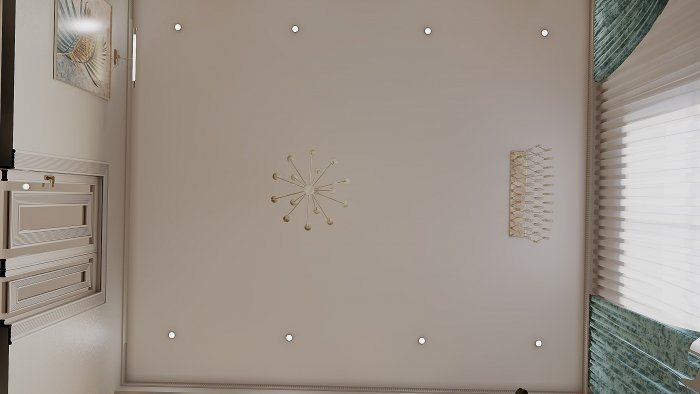
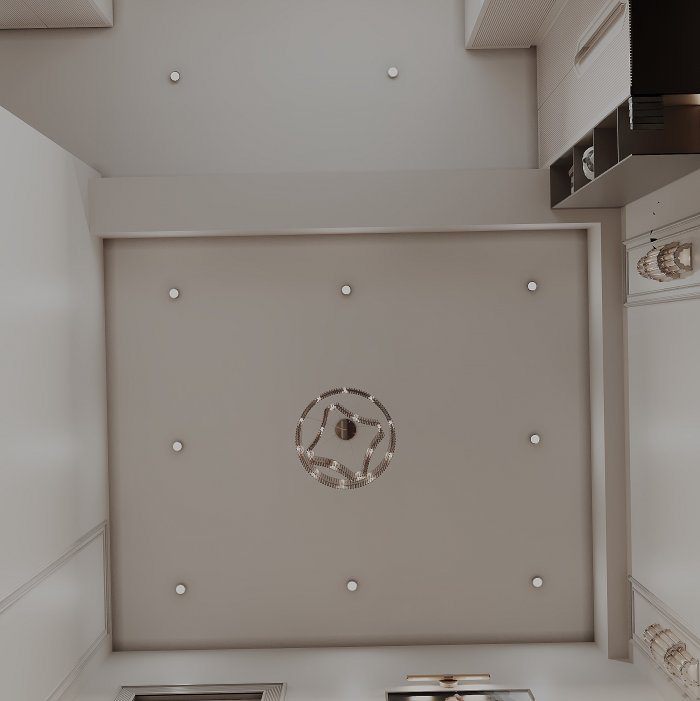
If an air-conditioning unit sits above the window, its airflow should not hit the curtain directly; otherwise the curtain moves constantly and cool air does not spread evenly. The positions of these elements are shown together on the ceiling plan.
Plasterboard and stretch ceiling construction
In a plasterboard ceiling the pocket is formed while the frame is built. The track is fixed inside the pocket to the concrete or to a reinforced stud; plasterboard alone cannot carry the weight of curtains, especially heavy fabric and a motorised system.
In a stretch ceiling the pocket is created with special profiles and a timber or metal base for the track installed in advance. In both cases the inside of the pocket is painted the same colour as the ceiling, so no dark gap is visible from below.
Common mistakes
Problems that often come up with concealed curtain pockets:
- building the pocket too narrow before the number of curtain layers is known;
- leaving no room for the motor housing;
- fixing the track to plasterboard alone;
- ending the pocket at the window opening, so open curtains still cover the glass;
- not coordinating cabling, lighting and air-conditioning on the ceiling plan.
Zaferoğlu İnşaat designs ceiling and window solutions together with the curtain system, and the company's Curtain division helps choose fabrics and decor to suit the interior. Tell us how many curtain layers you want and whether they will be motorised, and we can size the pocket from that.
News