
Porcelain Stoneware vs Ceramic Tile: Differences and Choice
How porcelain stoneware and ceramic tile differ in manufacture, water absorption, strength, slip resistance and installation, and where to use each.
In a tile showroom, two products of the same size and pattern can sit side by side: one ceramic, the other porcelain stoneware. From a distance the difference is hard to see, yet on a floor, in a kitchen, on a balcony or in a bathroom, these two materials perform differently over the years. To choose well, it is enough to understand how they are made and which properties set them apart.
How they are made
Both are made from a clay-based mix that is pressed and fired at high temperature. The differences lie in the composition, the pressing force and the firing regime.
Ceramic tile has a more porous body. Its face is usually covered with glaze, and the colour and pattern sit in that glaze layer. Most wall tiles belong to this group.
Porcelain stoneware is made from more refined raw materials, pressed at very high pressure and fired at a higher temperature. The result is a very dense, almost non-porous body.
Water absorption: the key indicator
One of the most important figures in tile classification is water absorption. Under the international standard ISO 13006 and the European standard EN 14411, porcelain stoneware belongs to the group with water absorption of 0.5 percent or less. Ceramic wall tiles have considerably higher absorption.
This difference has practical consequences:
- Frost resistance: water in the pores expands when it freezes and breaks the tile apart. Dense porcelain suits open balconies, terraces and steps, while porous wall tile is not used outdoors.
- Stain resistance: a dense body absorbs little liquid. However, some polished porcelain tiles can have open micro-pores at the surface, and the manufacturer may recommend a protective treatment for them.
- Strength: porcelain is more resistant to bending and impact and is reliable for floors with heavy furniture and heavy foot traffic.
Glazed and full-body porcelain
Porcelain comes in different types too, and this difference is often overlooked.
- Full-body or technical porcelain: the colour is the same through the entire thickness. Even if it wears or chips at an edge, the damage is hardly visible. It suits public spaces and heavily loaded floors.
- Glazed porcelain: a decorative glaze layer sits on top of the dense body. Rich designs such as marble, wood and concrete effects are mostly in this group. The surface is wear-resistant, but a deep scratch or chip may reveal a body of a different colour underneath.
For glazed tiles, the surface abrasion resistance is indicated by the PEI class. When choosing floor tiles, check that this class matches the load on the room.
Slip resistance
In kitchens, bathrooms, entrances and outdoor areas, slip resistance is a safety matter. It is measured with various test methods. Under the German DIN 51130 R classes, for example, a higher number means greater resistance to slipping. Glossy, polished surfaces look attractive but can be slippery when wet. For wet zones and outdoors, a matt, textured surface is the better choice.
Effect on installation
The density of porcelain also changes how it is installed:
- Adhesive: a non-porous tile does not bond well with basic cement adhesive. Improved adhesives, usually of class C2, are required, and deformable adhesives are recommended for large formats.
- Cutting and drilling: the material is very hard and needs a quality cutter and diamond drill bits.
- Base: large, heavy porcelain tiles need a flat base, otherwise their edges end up stepped.
Ceramic wall tile, by contrast, is light, cuts easily and is convenient to work with on walls.
Choosing by zone
- Kitchen floor and dining area: porcelain with a matt or semi-matt surface.
- Kitchen splashback: both ceramic tile and porcelain work; design and ease of cleaning matter most here.
- Bathroom walls: ceramic tile is a common and practical choice, with porcelain on the floor.
- Balcony, terrace and steps: frost-resistant porcelain with a textured, anti-slip surface.
- Hallway and entrance: wear-resistant porcelain.
Checking these points at the time of purchase prevents problems later:
- The water absorption group and intended use in the product documentation.
- For floors, the PEI class or whether the tile is full-body.
- The slip resistance class.
- Calibre and shade batch: the whole quantity should come from one batch.
- Extra quantity for cutting and spares.
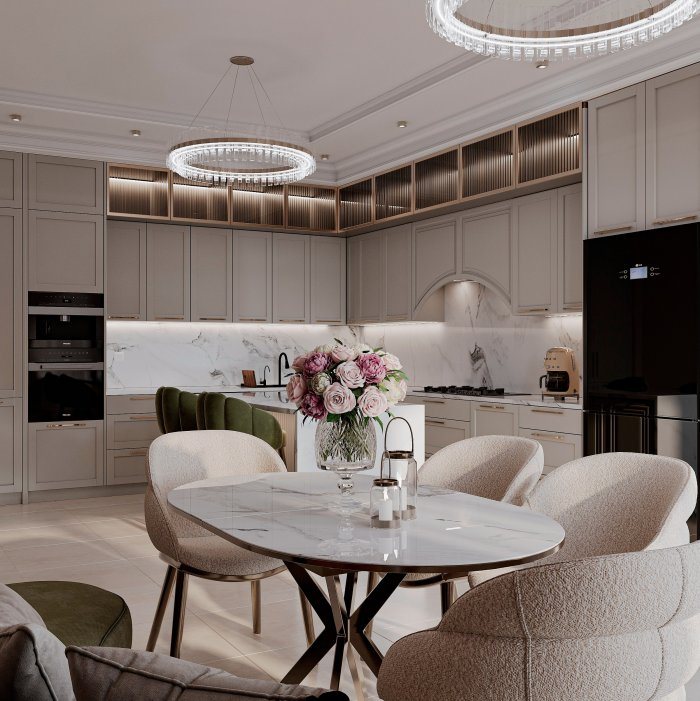
Zaferoğlu İnşaat selects floor and wall finishes by function when designing kitchens and dining areas and shows the tile layout in a computer model. For advice on choosing tiles, you can contact our office.
News