
Window Treatments for Offices and Commercial Spaces
In offices, cafés and shops, window treatments work differently from home curtains: screen glare, privacy, fire safety, heavy daily use and a consistent facade all come into play.
At home, curtains mostly serve one family's taste and habits. In an office, restaurant, beauty salon or shop, dozens of people use the same window every day, nobody looks after the curtain as their own, and cleaning follows a schedule. On top of that, a commercial window is also the face of the building and the brand as seen from the street. That is why the selection criteria line up in a different order.
Offices: screens, working comfort and acoustics
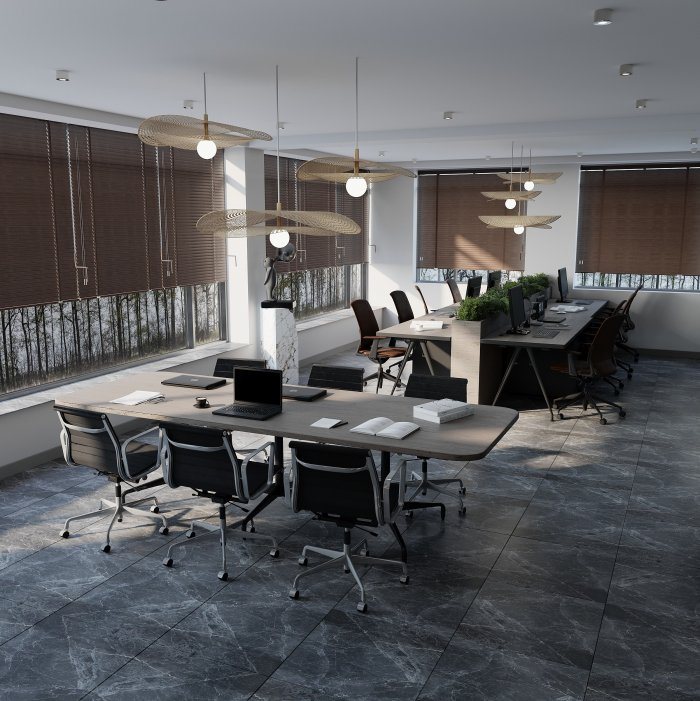
In an office the main job of window treatments is to reduce eye strain. Direct sunlight falling on a monitor or desk causes glare, and staff end up closing the blinds completely and working under artificial light. Solutions that filter light rather than shut it out prevent this:
- roller blinds in screen fabric cut glare during the day while keeping the view;
- horizontal aluminium Venetian blinds can tilt their slats to bounce light towards the ceiling;
- vertical blinds are handy on wide windows and where the sun's direction shifts through the day.
If a meeting room has a projector or large display, a blackout roller or room-darkening curtain is planned separately. In open-plan offices, glass partitions and many hard surfaces reflect sound; there, fabric curtains and acoustic textiles can improve the sound environment, although a serious acoustic problem cannot be solved by curtains alone.
Hospitality and beauty salons
In cafés and restaurants, window treatments must meet hygiene needs as well as guest comfort. With cooking odours, grease-laden steam and intensive cleaning, fabrics that come down and wash easily, and wipeable Venetian and roller blinds, have the advantage. How the dining room looks from the street in the evening matters too: some venues want to keep the shop-window effect, others prefer a more enclosed, intimate atmosphere.
In beauty salons, clinics and treatment rooms, privacy comes first. Solutions here include treatments covering the lower part of the window, dense sheers, fabrics that make it harder to see in during the day, or a light curtain combined with frosted glass.
Shops and display windows
A shop window is a sales tool, and nobody wants to cover it. Yet direct sun heats goods on display and fades packaging and textiles. Screen roller blinds soften that effect while partly preserving the view of the display. If there is an awning or external shade outside, the internal solution can be lighter.
Fire safety and durability
In public spaces where people gather, textile materials may be subject to specific fire-safety requirements. These vary by country, building use and local regulations, so the applicable rules should be confirmed at the design stage. In practice, flame-retardant fabrics are chosen, either inherently flame-resistant fibres or specially treated materials, and their certificates are kept on file.
In shops and offices, window coverings are raised and lowered again and again every day. The durability of the mechanism, the quality of chains and cords and the strength of the track therefore matter more than at home. Where children may be present, such as cafés and waiting areas, cord safety also needs thought.
A consistent look and centralised control
In a multi-storey office building, if every office picks a different colour, the facade looks chaotic from the street. Many buildings therefore set a single colour for the street-facing side, while the interior side can vary. In large offices, motorised systems are controlled in groups: all blinds closing at the end of the working day, or the sunny side lowering at midday, can be handled by programmed scenes.
Selection checklist
- What is the room mainly used for: screen work, meetings, receiving guests, sales?
- Is privacy needed during the day, or only in the evening?
- Do local regulations impose fire-safety requirements on textiles?
- How and how often will cleaning be done, and who will take the curtains down and rehang them?
- Is the mechanism built for heavy use?
- Does the side visible from the street suit the overall look of the building?
Zaferoğlu İnşaat's portfolio includes projects for public and commercial premises such as a business centre, a coffee shop, a restaurant and a beauty centre. In spaces like these, designing window treatments together with lighting, acoustics and the cleaning plan avoids changes that bring extra costs later.
News