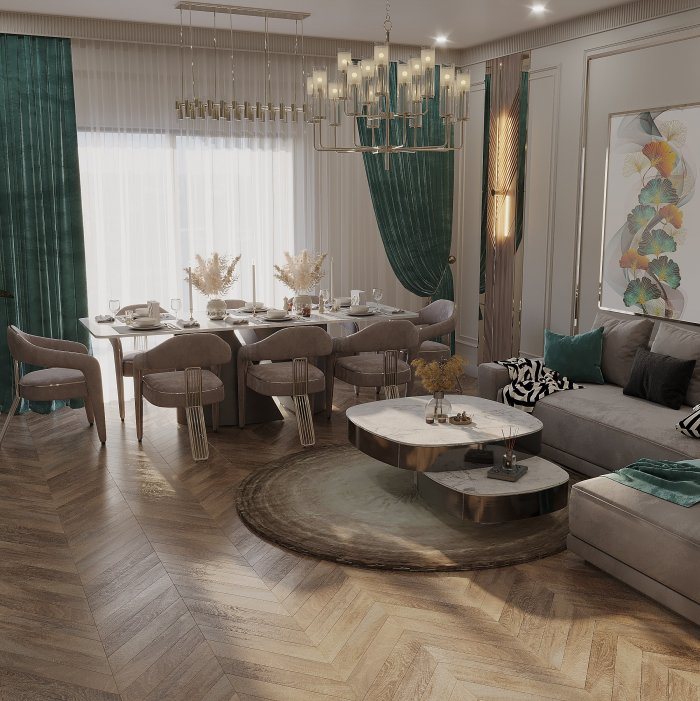

Measuring for Curtains: Width, Drop and Fullness

Curtains are measured not from the window but from the track and the look you want. Fullness determines the width, and the relationship to the floor determines the drop.
The most common mistake when ordering curtains is measuring from the glass or the window opening. The result is curtains that look flat and skimpy when closed, fall short of the floor or, conversely, drag along it. Curtains are measured after three decisions: where the track will go and how wide it will be, how the curtain will meet the floor and how much fullness the fabric will be gathered with.
Track first, then measurements
Measurements are always taken from the track. If it has not been installed yet, its exact position and type are fixed first, because the height difference between a wall-mounted and a ceiling-mounted track changes the curtain drop.
The track is usually wider than the window opening on both sides. This extra length is where the curtains stack when open. If the track is the same width as the opening, open curtains cover part of the glass, less light enters and the window looks smaller. If there is no room at a corner or a side wall is close, a curtain that opens to one side is also an option.
Width and fullness
The track length is measured, but the fabric must be considerably wider. The fullness ratio shows how many times wider the fabric is than the track. Light sheers use a higher ratio and heavy fabrics a lower one, because heavy fabric looks full even with less gathering.
The heading type affects the ratio too:
- simple gathered tape: folds are irregular, and the ratio is chosen by fabric weight;
- pencil pleats or double and triple pinch pleats: a classic look that needs more fabric for crisp folds;
- wave heading: creates even, rhythmic waves, with the ratio set by the special tape and the carrier spacing on the track;
- eyelet curtains: the number of eyelets should be even so both edges turn back towards the wall.
If the curtain is in two panels, the total width is divided in two, with a little extra allowed for the panels to overlap in the centre. Seam allowances are also kept for turning in the side edges.
Measuring the drop
The drop is measured from the hook or glider point on the track to the floor, not from the top of the track. The difference may be a few centimetres, but it shows clearly where the curtain meets the floor. Take measurements at the left, right and centre of the window, since floors and ceilings in older buildings are often not perfectly level. The smallest figure is used, or if the difference is large, it is accounted for when sewing.
There are three main choices for how the curtain meets the floor:
- a centimetre or two above the floor: practical, does not collect dust and is easy to vacuum around;
- just touching the floor: a fuller, finished look;
- pooling on the floor: a dramatic, classic effect, sensible only in rooms with little traffic and no pets.
For short curtains to the sill, a length that falls slightly below the sill is usually chosen so the edge looks straight and neat.
Fabric properties and measurements
Some fabrics shrink on first wash, while others lengthen slightly under their own weight after hanging. Natural fibres are more prone to shrinking. So ask about the fabric's properties before sewing, and sometimes a reserve is left in the hem so the length can be finalised after the curtain has hung for a while.
With patterned fabrics, the pattern repeat also affects the measurement: extra fabric is needed to match the pattern at the same height when panels are joined. If the fabric roll is narrower than the window height, where a seam will fall is planned in advance too.
Typical measuring mistakes
- measuring from the window frame;
- sewing curtains before the track position is confirmed;
- measuring the drop at only one point;
- ignoring radiators, sills or furniture that will obstruct the curtain;
- forgetting which way the balcony door opens;
- measuring sheers and drapes separately using different principles in a two-layer set.
Short checklist
- Are the track type, position and length confirmed?
- Which way and how will the curtain open?
- Have the heading type and fullness ratio been chosen?
- Has the drop been measured at three points from hook level?
- Has the relationship to the floor been decided?
- Have shrinkage and pattern repeat been considered?
Once measurements are taken, fabric, style and accessories can all be chosen in one place at Pərdə Zaferoğlu. If you want to finalise measurements and heading type together with your fabric choice, contact the showroom.
News