
Roller and Venetian Blinds: Where They Beat Curtains
Roller and venetian blinds take little space, control light precisely and are easy to clean. In kitchens, studies, offices and over furniture they are often more practical than curtains.
Not every window suits gathered fabric curtains. If there is a desk, kitchen worktop or radiator under the window, long curtains get crushed, soiled or cannot close at all. In an office, the sun angle changes through the day and creates glare on screens, so light has to be controlled precisely. These are exactly the places where roller blinds and venetian blinds come into their own. They can replace curtains entirely or complement them.
How roller blinds work
A roller blind is a flat panel of fabric wound onto a roller at the top. Lowered, it covers the window completely; raised, it rolls up and takes almost no space. It is operated by a chain, a spring mechanism or an electric motor.
The fabric type determines what a roller blind does:
- translucent fabrics reduce visibility during the day while keeping the light;
- open-weave screen fabrics let you see outside while reducing solar glare and heat;
- blackout fabrics block light completely;
- zebra or day-and-night double fabrics alternate sheer and solid stripes, and light is adjusted by sliding them relative to each other.
Types of blinds
Blinds are made of slats and control light by changing the slat angle. Horizontal venetian blinds come in aluminium, wood or faux wood; they can direct light upwards towards the ceiling, keeping the room bright while preventing people from seeing in.
Vertical blinds use fabric slats and are mainly used on wide, tall windows and in offices. The slats stack to one side, so the window can be fully cleared. Vertical slats collect less dust than horizontal ones.
Where they beat curtains
Roller and venetian blinds have a clear advantage in these situations:
- kitchens: less sensitive to steam and grease, and aluminium blinds or wipe-clean roller fabric are easy to clean;
- a desk or worktop under the window: nothing hangs down, and the surface stays clear;
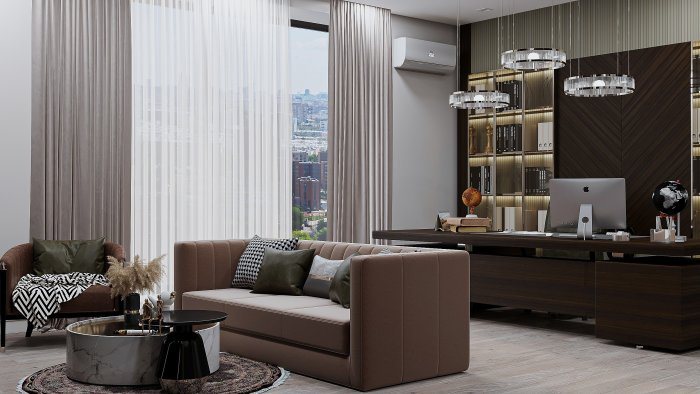
- studies and offices: precise light control prevents glare on monitors;
- bathrooms: moisture-resistant materials are available;
- attic and roof windows: systems with side guides stay in place on sloping glass;
- opening window sashes: a frame-mounted system opens with the sash and does not get in the way.
Where they fall short
Roller and venetian blinds have limitations too. They do not give the warm, soft look of fabric curtains and on their own can make living rooms and bedrooms feel like offices. They absorb less sound than curtains. Without side channels, gaps at the edges mean they do not give full darkness. Horizontal slats gather dust and need regular wiping.
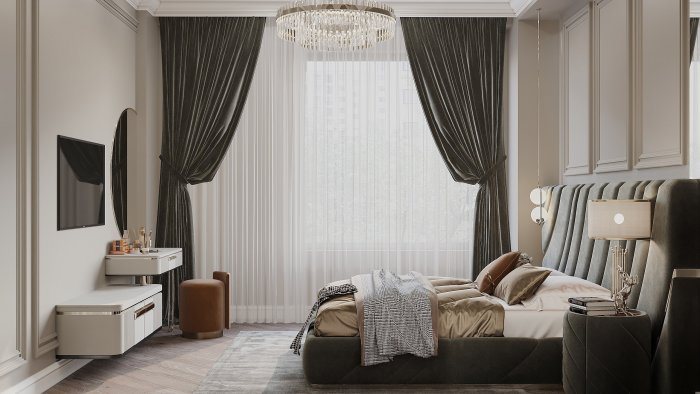
That is why living spaces often use a combination: a roller blind or venetian blind at the window to control light, with decorative fabric curtains in front.
Installation options
Roller and venetian blinds are installed in three main ways. Inside the reveal looks neat and compact, but the reveal depth and window handle projection must be checked. Outside the reveal, on the wall or ceiling, covers the window completely and reduces light leakage. On the frame, over each sash, lets the sashes open independently.
When measuring, check whether the opening is square: in older buildings the width at the top and bottom may differ. If a motorised system is planned, power is run to the top corner of the window during renovation.
Quick questions for choosing
- What is under the window: furniture, a radiator, a worktop?
- Do you need to diffuse, adjust or fully block light?
- Is there moisture, steam or grease in the room?
- Do the window sashes open, and will the system get in the way?
- A blind on its own, or combined with fabric curtains?
- Is fitting inside or outside the reveal more suitable?
Pərdə Zaferoğlu's range of fabrics and colours helps coordinate blinds with the rest of the room's textiles. To judge how a roller blind or venetian blind looks together with fabric curtains using real samples, you can contact the showroom.
News