
Roman Blinds: Features and the Interiors They Suit
A Roman blind is a flat fabric panel that folds up in horizontal pleats. It combines the softness of fabric with the compactness of a roller blind and suits small windows especially well.
A Roman blind sits somewhere between a classic curtain and a roller blind. Lowered, it covers the window as a flat, smooth panel of fabric. Raised, the fabric gathers upwards in horizontal folds thanks to rods sewn into the back. The window keeps a soft textile look, but the blind neither spreads to the sides nor hangs to the floor. This makes it ideal for some rooms and out of place in others.
Construction and mechanism
Horizontal pockets are sewn across the back of a Roman blind at set intervals, and thin rods are inserted into them. Cords or tapes run down from the headrail and are attached to these rods. When the cord is pulled, each lower fold lifts onto the one above and the blind stacks neatly.
There are several ways to operate it:
- cord and cleat: simple, but the cord hangs long;
- chain mechanism: the blind stays at any height and is easier to control;
- electric motor: especially convenient for tall or hard-to-reach windows.
In homes with children, cords and chains must be secured at a height out of the child's reach.
Types of Roman blind
The shape of the folds changes the blind's character. A flat, classic Roman blind has crisp, geometric folds that suit modern interiors. In the relaxed-fold version, the fabric between the rods dips slightly, giving a more casual, homely feel. A cascade blind keeps several folds visible even when lowered, which looks more decorative.
Choosing fabric
Fabric for a Roman blind needs to be dense enough and to fold neatly. Medium-weight linen, cotton and blends are used most. Very thin fabric does not hold its shape in the folds, while very thick, heavy fabric forms a bulky stack when raised and covers much of the top of the window.
Lining matters here too. It protects the face fabric from the sun, makes the folds neater and can add a blackout function if needed. With patterned fabrics, think in advance about how the pattern will look in the folds: a large motif may appear only in fragments when the blind is raised.
Interiors it suits
Roman blinds work especially well in these cases:
- kitchens: they do not hang over the worktop below the window and let in as much light as you like;
- children's rooms and studies: compact, allowing a desk or sofa to sit in front of the window;
- small and narrow windows: they need no space at the sides;
- windows next to balcony doors: they do not obstruct the door;
- modern, Scandinavian and rustic interiors: their straight lines and natural fabrics suit these styles.
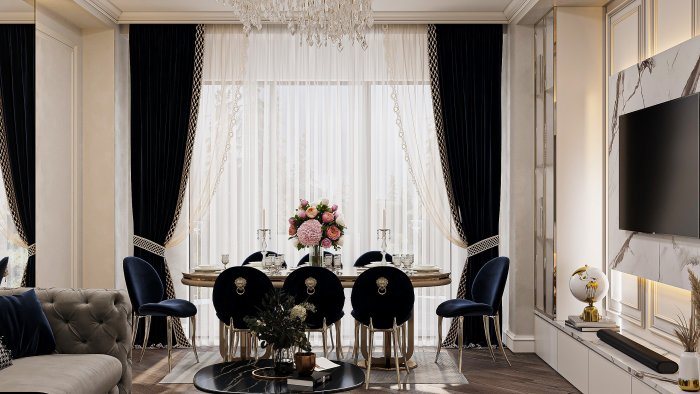
In classic interiors, a Roman blind can be used together with decorative side curtains. The Roman blind then handles light, while the side curtains provide the look.
Limitations
On very wide windows a single Roman blind becomes heavy and the folds can sag in the middle, so several separate blinds are recommended. When raised, the folds take up some height at the top of the window, cutting out part of the light on low windows. That is why the blind is sometimes mounted a little above the opening. Washing a Roman blind also requires removing the rods, which takes longer than with ordinary curtains.
A Roman blind is installed inside or outside the window reveal. Inside, it must not catch on the window handle; outside, it is made slightly wider than the opening to reduce light leaking at the sides. Measurements are taken at several points in the opening, because a straight blind leaves gaps at the edges of an uneven reveal.
Short selection list
- Is the window width suitable for a single Roman blind?
- Will the folds be flat, relaxed or cascade?
- Is the fabric medium-weight, and does it hold its shape in folds?
- Is a lining needed, and is blackout required?
- Will it be operated by cord, chain or motor?
- How much of the window light will the raised folds cover?
When picking fabric for a Roman blind, you can browse Pərdə Zaferoğlu's colours and textures and choose trims at the same time. If you want to see a suitable fabric for a Roman blind, how it feels and how it folds, you can contact the showroom.
News