
Finishing Stair Treads: Stone, Timber or Tile
Natural stone, timber and ceramic tile compared for stair treads: safety, noise, care, nosing details and why accurate step heights matter.
A staircase is one of the hardest-working and highest-risk elements in a home. Its finish shapes the look of the interior and has to make going up and down dozens of times a day safe. That is why tread material is never chosen by colour alone: slip resistance, the nosing, noise, maintenance and consistent step dimensions matter just as much.
Structure and dimensions come first
A finish sits on the stair structure; it does not correct it. If a concrete staircase has uneven risers or goings, those differences have to be levelled before finishing. The detail most often forgotten is the first and last step: when the thickness of the floor finish at the bottom and the landing finish at the top is ignored, those two steps end up a different height from the rest.
People pick up the rhythm of a staircase quickly and trip on a step of a different height. So every step is measured before the finish is chosen, and finished levels are calculated on the drawing.
Natural stone: durable but hard
Marble, granite and other natural stones are widely used on hall and villa staircases. They resist wear, keep their appearance for a long time and suit classic interiors naturally.
Stone has its weak points. Polished stone treads become slippery, especially in socks or with wet shoes. To counter this, anti-slip grooves are cut near the front edge, or the surface is honed or brushed. A stone tread is also less forgiving in a fall, which matters in homes with small children or elderly family members.
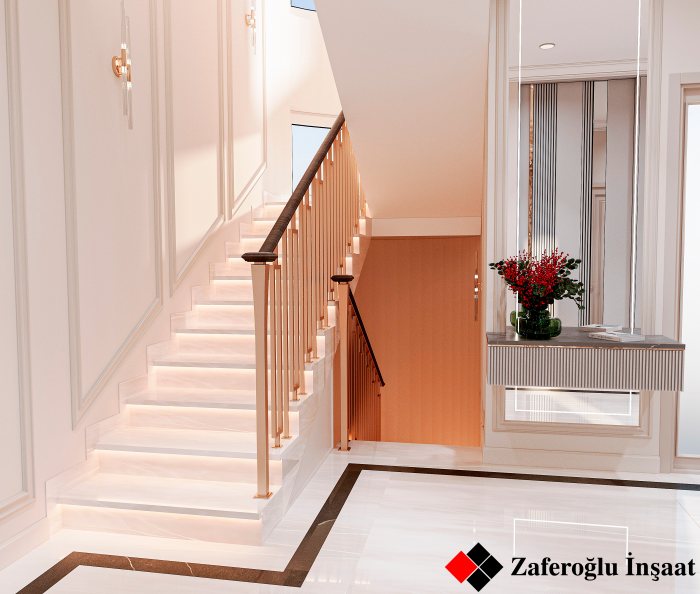
Stone stairs usually combine a thick solid tread with a thinner riser panel. The front edge is rounded or chamfered so it does not chip or injure a foot.
Timber: warm and quiet
Timber treads feel warmer, sound softer underfoot and bring comfort to a home. Hardwoods such as oak or ash are suitable; softwoods dent quickly.
The key requirement for timber is stable humidity. Treads fitted in a building that still holds construction moisture can later creak, crack or warp. That is why timber is installed only after wet trades are finished and the building has dried out.
The surface is protected with lacquer or oil. Lacquer forms a tougher film but is hard to repair locally once scratched. An oiled surface looks more natural and can be refreshed in patches, though it needs more frequent care. To reduce slipperiness, semi-matt finishes or discreet anti-slip strips along the nosing are used.
Ceramic tile: practical but detail-sensitive
Porcelain stoneware treads resist moisture, stains and wear, and are easy to look after. They suit yards, terraces and service stairs particularly well. Special stair tiles with a pre-formed nosing are also available.
When ordinary tiles are used, the front edge is the weak point. A mitred joint between two tiles at the edge chips when knocked and the cut shows. The solution is either a ready-made stair tile or a metal or aluminium nosing profile. Outdoors, choosing a surface with a high slip-resistance rating is essential.
Questions to guide the choice
To make the decision easier, answer these questions:
- is the staircase indoors or outdoors;
- whether toddlers, older relatives or pets will use the stairs;
- how important is noise: timber and carpet dampen sound, stone and tile amplify it;
- which floor does the stair connect to, and do you want a continuous look;
- how much time are you willing to spend on maintenance.
Whatever the material, a clearly visible nosing improves safety. Concealed LED lighting along the treads or a contrasting strip at the edge makes each step more reliable in the evening.
Balustrade and junction details
The tread finish should be planned together with the balustrade posts. If posts are to be fixed by drilling into stone after finishing, the hole positions are set out in advance so the stone does not crack. Where the tread meets the wall, a skirting or shadow gap prevents dust from collecting and protects the wall from knocks.
Zaferoğlu İnşaat develops staircase solutions together with the overall interior design in its villa and apartment projects. Tell us the number and width of the treads and who will use the stairs most, and we can weigh stone, timber and tile against that.
News