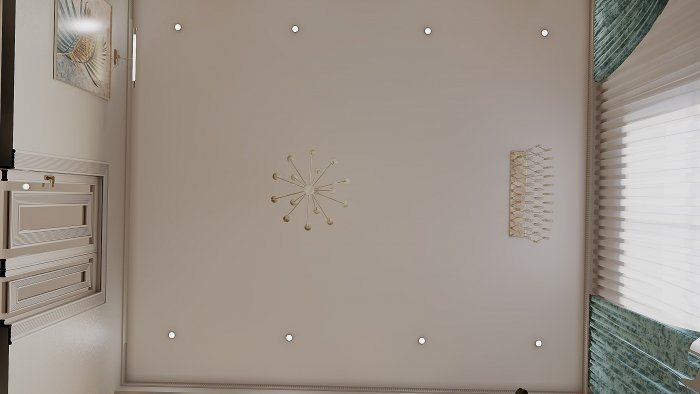

Stretch Ceilings: Advantages, Limits and When to Install
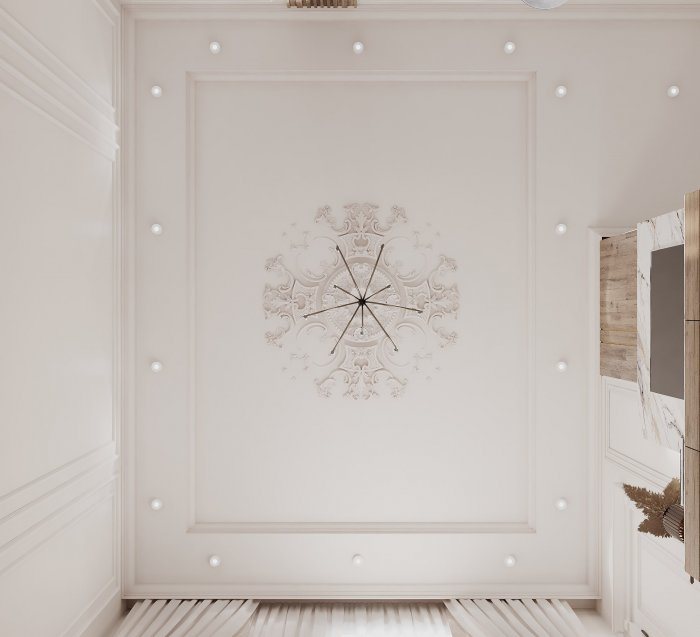
How a stretch ceiling is installed, matt, gloss and fabric types, its real advantages and weak points, lighting details and when it goes in during a renovation.
A stretch ceiling is quick to install and gives a flat, clean surface. It is often compared with plasterboard, but the two systems work differently and suit different situations. Knowing the real advantages and limitations of a stretch ceiling before choosing it, especially regarding lighting and the order of work, saves trouble later.
How a stretch ceiling is installed
A special profile, the perimeter track, is fixed around the room to the walls or ceiling. A PVC membrane or special fabric made to measure is clipped into this track and tensioned. PVC membranes are warmed during installation to make them pliable, and they tighten into a flat surface as they cool. Fabric ceilings are usually tensioned without heating.
A void remains between the slab and the membrane, housing cables, mounting rings for light fittings and sometimes ventilation components. Its depth is set by the requirements of the chosen lights and the profile system.
Types and finishes
Stretch ceilings differ by surface:
- matt looks most like a plastered and painted ceiling and is neutral for most interiors;
- satin has a slight sheen and reflects light softly;
- gloss mirrors the room and adds a sense of height, but seams and reflections are more noticeable;
- fabric gives large seamless areas and a more natural texture;
- translucent membranes are used for backlit panels.
In large rooms where the membrane is not wide enough, a welded seam is needed. Its position should be agreed at the measuring stage: a seam parallel to the window is less visible in daylight.
Advantages
The strengths of a stretch ceiling are:
- installation is fast and relatively clean, without dusty skimming and painting;
- unevenness and cracks in the concrete are completely hidden;
- a PVC membrane can hold a certain amount of water from a leak above; a specialist drains it and the membrane can often be reused;
- the surface does not crack over time and keeps its colour;
- when properly specified, it works well in humid rooms.
Limitations and weak points
The system has its limits, and they are worth knowing in advance:
- the membrane is easily punctured or scratched by sharp objects, so care is needed when moving furniture or opening champagne;
- a puncture can be repaired locally, but an invisible repair is not always possible;
- PVC loses flexibility at very low temperatures, so it is not suitable for unheated spaces;
- hot-running lamps must not sit close to the membrane; special thermal rings and cool-running LED fittings are used;
- adding a new light point later is difficult, because the mounting ring has to be installed before the membrane is stretched;
- complex curves, small steps and slim light lines are easier to build freely in plasterboard.
The lighting plan must be ready in advance
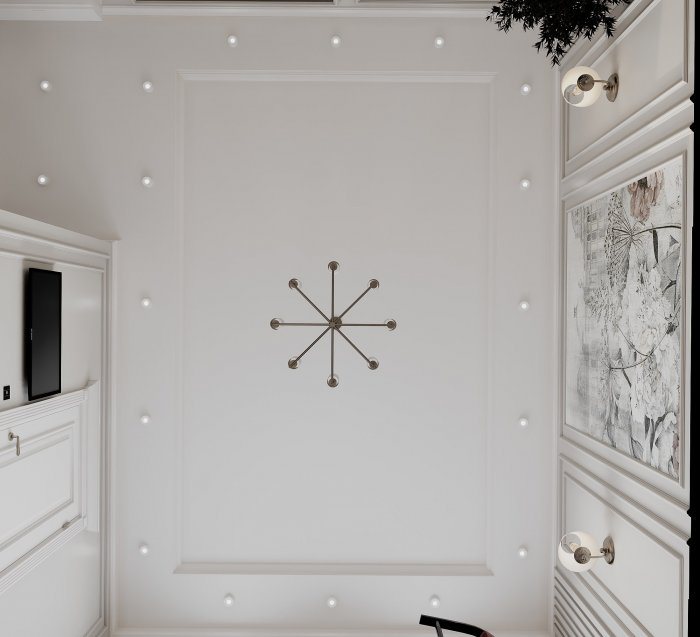
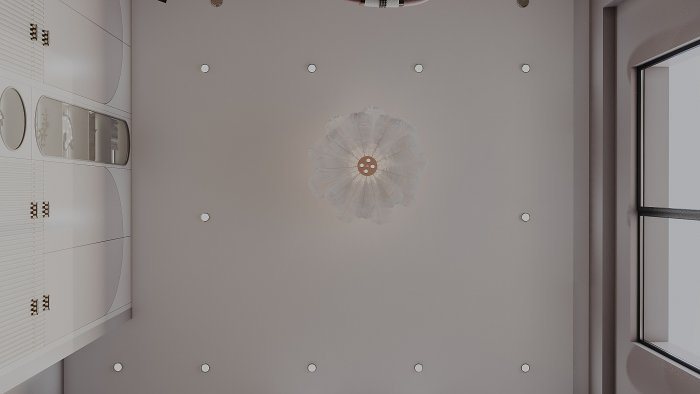
With a stretch ceiling, a separate fixing point is prepared for every light, track and linear profile before the membrane is stretched. Each fitting's position, diameter, type and power must be known when measurements are taken. A hook or platform anchored to the concrete is installed for a chandelier.
Modern stretch ceiling systems also allow recessed linear lights, shadow-gap profiles and curtain pockets. These need extra profiles and should be shown in the overall ceiling design.
When it is installed during renovation
A stretch ceiling goes in towards the end of the finishing work. Before that, the following must be complete:
- electrical cabling and cable outlets for lights;
- air-conditioning and ventilation lines;
- wall plastering, skimming and at least the first coat of paint;
- tiling and any dusty cutting work.
If the final coat of wall paint is applied after the ceiling, the ceiling edge must be protected. Flooring is usually laid after the stretch ceiling, since ladders and heating equipment are used during installation. Service hatches for air-conditioning or ventilation inspection should also be planned in advance.
Zaferoğlu İnşaat recommends a ceiling type based on room height, lighting plan and interior style. Torn between stretch and plasterboard? Bring your ceiling height and lighting plan and we will compare them.
News