
Choosing Skirting Boards: Height, Material and Wall Match
What skirting does, MDF, timber, polyurethane, metal and flush skirting compared, choosing height to suit the room, and deciding on colour.
Skirting boards are among the last things installed in a renovation, which is why they rarely get much thought. Yet the line where wall meets floor runs around the entire perimeter of the room and does more for a finished look than people expect. Skirting that is too low gets lost in a high-ceilinged room, while the wrong colour can visually cut across furniture and doors.
What skirting is for
The first job of skirting is technical. Floors such as laminate and parquet are laid with an expansion gap at the wall, and that gap has to be covered. Skirting also protects the bottom of the wall from vacuum cleaners, mopping and knocks from furniture.
The second job is aesthetic. Skirting hides small irregularities at the edges of walls and floors and gives the room a clear base line. In classic interiors it forms a single moulding system together with the ceiling cornice and door architraves.
Height: relative to ceiling and style
There is no fixed rule for skirting height, but the logic is simple: the taller the room, the taller the skirting can be. In an apartment with a standard ceiling height, a medium skirting looks natural. In villas and classic reception rooms with high ceilings, taller profiled skirting keeps the proportions right.
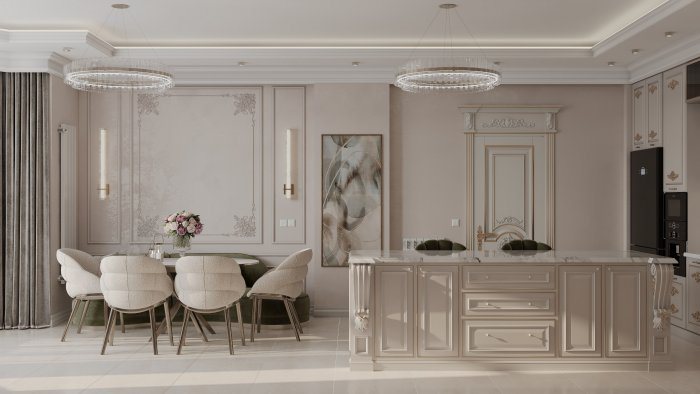
Style has an effect too. Minimalist interiors use a low, plain profile or a flush skirting that is barely visible. In neoclassical and classic styles, the skirting usually speaks the same language as the cornice, with a similar profile.
When choosing height, check the socket positions: very tall skirting can run into low-mounted sockets or cut across them. This needs to be considered during the electrical work.
Choosing the material
Each material has its place:
- MDF skirting takes paint well and is popular for tall, straight profiles, but it is sensitive to moisture;
- solid timber matches parquet, but can move and bow with humidity;
- polyurethane is unaffected by moisture, follows uneven walls better, can be painted and comes in a wide range of classic profiles;
- PVC is inexpensive and moisture-resistant but looks simpler; versions with a built-in cable channel are handy in utility rooms;
- aluminium creates a slim metal line in contemporary interiors and resists knocks;
- tile skirting is the most washable option for bathrooms, kitchens and commercial spaces.
In kitchens, hallways and entrances that are mopped often, the bottom edge of MDF skirting can swell over time. Polyurethane or aluminium is more reliable in these areas.
Colour: match the floor, the wall or the doors
Skirting colour is chosen in one of three ways, each with a different effect.
Skirting painted the same colour as the wall extends the wall down visually, making the room feel taller and calmer. This is the most common choice in contemporary interiors.
Matching the floor makes the floor look larger and is practical if the wall colour is likely to change. But dark skirting between a light wall and a dark floor sharply outlines the room's perimeter.
Skirting matching the door architraves, usually white, ties all the mouldings into one system in a classic interior. In that case, the detail where architrave meets skirting should be thought through in advance.
Flush skirting
Flush or recessed skirting that sits in the plane of the wall gives a minimalist look. A special aluminium profile is installed at the plastering or plasterboard stage. That means the decision has to be made early in the renovation; switching to flush skirting later requires reworking the bottom of the wall.
Installation rules
For skirting to look neat:
- walls and floor must be finished, with the final coat of paint applied;
- skirting is fixed to the wall, not the floor, so a floating floor can move freely;
- corners use precise mitres or ready-made corner pieces;
- the fine gap between skirting and wall is filled with flexible acrylic caulk and painted;
- on painted skirting, nail or screw holes are filled and covered with the final coat.
In its design projects Zaferoğlu İnşaat treats skirting, door architraves and ceiling cornices as one system of details. Send us photos of the room and we will help match skirting height to your door frames and cornice.
News