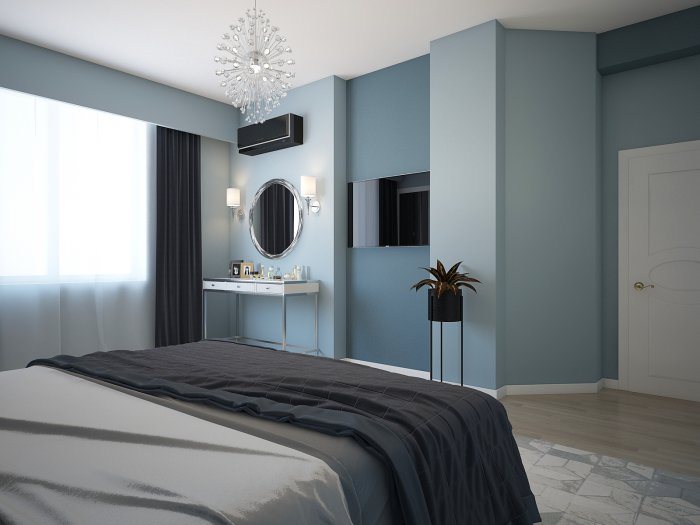

Curtains and Acoustics: Textiles That Soften Sound

Heavy fabric, generous folds and a gap from the glass reduce echo in a room. Knowing what curtains can and cannot do makes choosing them easier.
Anyone who has spoken in an empty room after a renovation has heard the voice bounce back off the walls. Once furniture, rugs and textiles arrive, that echo drops noticeably. Curtains usually cover the largest soft surface in the room, so they shape its acoustic character more than most people expect. To get real results from them, though, you need to understand the difference between absorbing sound and insulating against it.
Absorption and insulation are not the same thing
Sound insulation stops noise passing from one space to another. It relies on heavy, airtight and decoupled construction: thick walls, good glazing units and well-sealed doors. Sound absorption, by contrast, reduces how much of the sound produced inside a room reflects off its surfaces and keeps being heard.
Curtains mainly do the second job. In a soft, open-weave fabric, sound energy is partly lost as the fibres rub against one another. The result is clearer speech, a tighter TV sound and less harsh footsteps or clattering dishes. Traffic noise from the street is only softened slightly; the real fix for that lies in the window itself.
Which fabrics absorb the most
Three properties of a fabric matter acoustically: its weight, the density of the weave and its thickness. Velvet, heavy linen, wool blends and multi-layer curtains behave very differently from thin synthetic sheers.
- Heavy, tightly woven fabrics absorb mid and high frequencies better.
- A lined curtain adds mass and thickness compared with a single layer.
- A soft interlining between the face fabric and the lining helps both acoustics and the way the curtain hangs.
- Tulle and light chiffon soften daylight but do little for sound.
Low-frequency sound, such as bass or the rumble of heavy engines, is barely affected by textiles. In a home cinema, curtains are therefore a supporting measure rather than an acoustic solution on their own.
A simple test helps when comparing swatches: hold the fabric up to the light. A weave that lets light through easily usually holds back little sound as well. Then squeeze the fabric in your hand and let go; a heavy, full fabric opens slowly and keeps a soft shape. This is no substitute for laboratory measurement, but it gives direction when two similar-looking fabrics sit side by side in a showroom. A blackout lining blocks light and some sound too, which makes it doubly useful in a bedroom.
Fullness and distance from the glass
Two curtains made from the same fabric can perform differently. In a generously gathered curtain, a sound wave meets a larger surface and the air pockets between the folds. A rule widely used by curtain makers is to take a fabric width of roughly twice the length of the rail, which works far better acoustically than a narrow, flat panel.
The air gap between curtain and glass also matters. A curtain pressed against a wall or window absorbs less, while one hung slightly forward works over a broader range thanks to the space behind it. A ceiling-mounted track or a rail extending beyond the window opening creates that distance.
Think of curtains as part of the whole room
Acoustic problems usually come from several hard surfaces together: large glazing, polished stone floors, bare walls and a high ceiling. Curtains soften the window side; the other surfaces need attention too.
In a living room, a rug, upholstered furniture and bookshelves work with curtains to create a balanced sound. In a bedroom, an upholstered panel behind the bed and heavy curtains strengthen the sense of calm. In an office meeting room with many glass partitions, curtains or acoustic textiles make speech easier to understand.
A short checklist before choosing
Before you pick a fabric, decide what you actually want to change in the room:
- if the issue is echo inside the room, choose heavy, lined curtains with plenty of fullness;
- if the issue is street noise, have the window and the tightness of its installation checked first;
- plan curtains wider than the window opening and running from ceiling to floor;
- combine sheers with heavy curtains for daylight during the day and quiet in the evening;
- ask how the fabric should be cleaned, as heavy curtains can change shape when washed.
When browsing Pərdə Zaferoğlu's fabrics for acoustic reasons, it is worth asking about each fabric's density and thickness. If the room echoes, feel the fabric's density by hand and work out how much fabric the full window width needs.
News