
Mirrors in Interiors: Expanding Space and Spreading Light
Placed well, a mirror enlarges a room and carries daylight deeper inside; placed badly, it doubles the clutter. Guidance on position, size, fixing and care.
The mirror is one of the oldest and most effective tools in interior design. It opens up a wall, carries light into the darker part of a room and gives a small space depth. But a mirror is not selective: it reflects the garden view through the window and the clutter on an open shelf with equal precision. So where a mirror goes is as much a planning decision as a decorative one.
What will the mirror reflect
Before placing a mirror, the key question is: what is opposite it? A mirror doubles whatever it faces, so:
- a window, garden view, beautiful lamp or artwork makes the space richer;
- a kitchen worktop, open storage shelves or TV cables increase clutter;
- a door or long corridor directly opposite can create unsettling unexpected movement.
Standing where the mirror is planned and looking at the opposite side — or even taking a photo from that angle with a phone — is a simple but useful check before deciding.
Positioning to spread light
A mirror is not a light source, but it redirects light. A mirror on the wall beside a window carries daylight deeper into the room. A mirror directly opposite a window bounces light back and can dazzle in a sunny room; in a dark room the effect can be helpful, but the position needs careful thought.
In the evening a mirror also multiplies artificial light. A mirror next to or opposite a wall light or table lamp acts like an extra light point. Integrated concealed lighting turns the mirror into an element that is both functional and decorative.
Size and shape
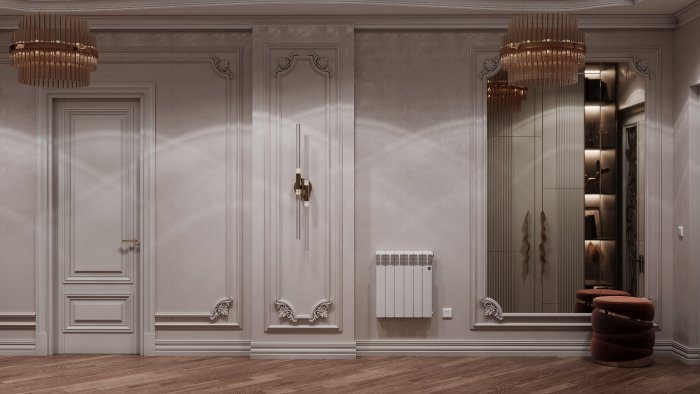
Small mirrors work as décor; large ones work as architecture. If the goal is to enlarge the space, the mirror needs to be big enough: a floor-to-ceiling mirror or a mirror panel covering much of a wall genuinely creates a “second room” effect. Many small mirrors read more as a decorative collage.
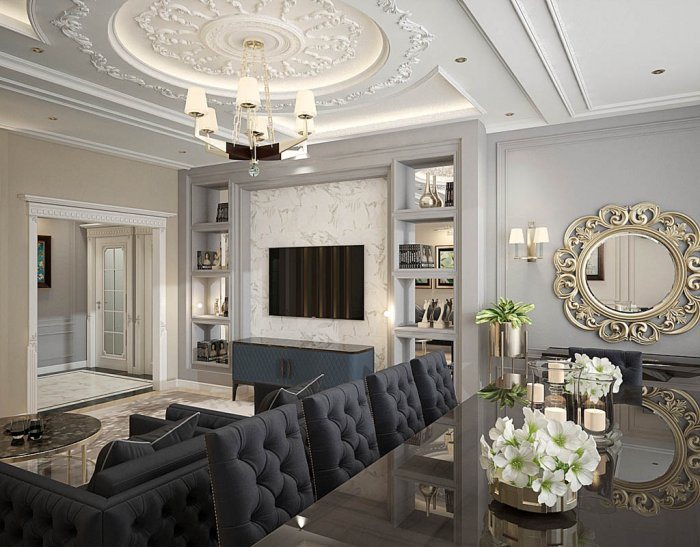
Shape relates to style. Classic and neoclassical interiors use framed rectangular or arched mirrors; modern interiors use frameless or slim metal-framed shapes; contemporary eclectic schemes use asymmetric, organic forms.
Mounting height matters too: a hallway mirror should show a person at full height, while a mirror above a console should be in proportion to the furniture and wall.
Mirror panels and large surfaces
Covering a large part of a wall with mirror is striking but needs technical preparation. The surface must be flat: on an uneven wall the reflection ripples. Large panels are divided into sections, with the joints planned as part of the composition.
In some interiors tinted (grey or bronze) or antiqued mirror is used instead of clear mirror. It gives a softer reflection and does not show the details opposite so sharply.
Fixing: a safety issue
Mirrors are heavy, and a falling mirror is a serious hazard. The fixing method depends on the mirror's size and the wall material:
- mechanical hangers or plugs for small mirrors;
- a combination of mechanical supports and dedicated mirror adhesive for large mirrors;
- solid backing installed in advance in plasterboard walls;
- an adhesive specifically intended for mirrors, with a neutral formulation that does not damage the silver backing.
Acid-curing silicone can gradually damage the reflective layer, which shows up as dark spots at the edges. Simply leaning tall, heavy mirrors against the wall on the floor is dangerous, especially in homes with children.
Bathrooms and damp rooms
In a bathroom a mirror is exposed to moisture, steam and cleaning products. Choosing moisture-resistant mirrors with finished edges and mounting them slightly off the wall helps ventilation behind. Heated anti-fog mirrors add daily comfort after a shower; in that case the electrical point is planned in advance.
For care, use non-abrasive cleaners and a soft cloth. Spraying cleaner onto the cloth rather than directly onto the mirror stops liquid seeping in at the edges.
In its interior projects Zaferoğlu İnşaat considers mirror placement together with the lighting plan and wall elevations and shows it in computer models. Mirror and lighting solutions can be discussed based on the orientation of your room's windows.
News